Explore our certified pharmaceutical, food, and enzyme-grade D-Trehalose Dihydrate (CAS 99-20-7) options. Verified with full lot traceability, non-GMO status, Kosher, and Halal accreditations for industrial batching.
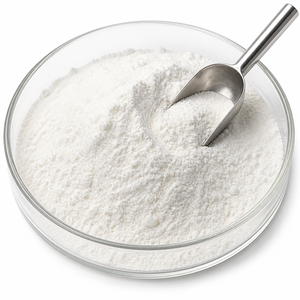
D-Trehalose dihydrate is a naturally occurring non-reducing disaccharide composed of two $\alpha$-glucose units joined by an $\alpha,\alpha-1,1$-glucosidic bond. Unlike sucrose or maltose, this unique symmetrical linkage renders the molecule exceptionally resistant to acid hydrolysis and thermal degradation. In industrial food processing, biopharmaceuticals, and advanced cosmetics, Trehalose operates far beyond a conventional functional sweetener—it functions as a premier cryoprotectant, glass former, moisture-retention agent, and protein stabilizer.
Because Trehalose does not undergo Maillard browning reactions due to its non-reducing chemical structure, formulators can subject it to high-temperature thermal sterilization or prolonged baking without altering product color or generating off-flavors. Furthermore, its exceptionally high glass transition temperature ($T_g = 115^\circ\text{C}$) allows food products and biologics to transition into a stable amorphous glass state upon drying, suppressing molecular mobility and preventing structural collapse during extended storage.
| Property Parameter | D-Trehalose Dihydrate | Sucrose | Maltose | D-Sorbitol |
|---|---|---|---|---|
| CAS Registry No. | 99-20-7 (6138-23-4 dihydrate) | 57-50-1 | 69-79-4 | 50-70-4 |
| Relative Sweetness (vs Sucrose=100) | 45% | 100% | 30% - 35% | 60% |
| Glass Transition Temp ($T_g$) | 115°C | 62°C | 87°C | -9°C |
| Maillard Reaction Potential | Zero (Non-Reducing) | Low (Hydrolyzes to reducing) | High (Reducing sugar) | Zero (Polyol) |
| Protein Stabilization Capability | Superior (Bioprotectant) | Moderate | Moderate | Low |
| Acid & Thermal Stability | Exceptional ($\text{pH } 3.0-10.0$) | Moderate (Inverts in acid) | Moderate | High |
Evaluating global manufacturing capacity, enzyme production methodologies, quality certifications, and supply chain reliability for commercial B2B procurement.
Tier 1 primary producers utilize patented multi-enzyme processes (converting liquefied starch via Maltooligosyltrehalose Synthase and Maltooligosyltrehalose Trehalohydrolase). These manufacturers control synthesis from raw corn or tapioca starch, yielding purity levels exceeding 99.2% with ultra-low endotoxin limits.
Focused on parenteral and biopharmaceutical applications, specialized excipient manufacturers subject crude trehalose to multi-stage crystallization, membrane filtration, and depyrogenation. Products strictly adhere to EP, USP-NF, and JP pharmacopeias for mAb lyoprotection.
Strategic stockists and regional distributors—such as US Sweeteners—bridge raw synthesis facilities with regional production lines. By maintaining palletized and tote inventory across nationwide multi-site facilities, lead times drop from weeks to days with guaranteed lot COAs.
Market projections indicate a compound annual growth rate (CAGR) of 6.8% for bulk Trehalose powder, driven by four structural shifts in global manufacturing.
With the rapid expansion of mRNA therapies, biologics, and cell/gene products, pharmaceutical buyers are increasing demand for parenteral-grade Trehalose. Trehalose acts as a molecular "water replacement," forming a protective matrix around sensitive proteins during freeze-drying (lyophilization) to prevent aggregation, denaturation, and activity loss during room-temperature logistics.
In frozen bakery products, noodles, and ready-to-eat meals, ice crystal growth destroys cellular texture and starch retrogradation causes staling. Trehalose tightly binds water molecules, reducing free-water activity ($a_w$) and preventing starch molecules from recrystallizing. Procuring food-grade Trehalose dihydrate allows commercial bakeries to double the shelf life of frozen dough without chemical emulsifiers.
Skincare formulators utilize cosmetic-grade Trehalose for anti-pollution and deep hydration serums. Beyond basic humectant properties, studies demonstrate that topical application stimulates autophagy—the cellular clean-up mechanism—protecting skin fibroblasts from oxidative stress, UV radiation, and severe dehydration.
Procurement teams are prioritizing ESG-compliant suppliers. Modern synthesis relies on sustainable cassava or cornfeed bioconversion utilizing recombinant enzymes with zero harsh chemical solvents. This yields a non-toxic, biodegradable, clean-label raw material that aligns with global net-zero goals.
For close to four decades, US Sweeteners has operated as a key supply link for bulk sugar, specialty polyols, and functional carbohydrates across the United States. We hold physical inventory on our warehouse floors rather than acting as a passive broker. When your automated batching line or processing facility operates on tight production cycles, our infrastructure ensures zero downtime.
Technical, regulatory, and commercial details for Trehalose Powder sourcing.
D-Trehalose Dihydrate carries the chemical CAS Registry Number 6138-23-4 (Anhydrous Trehalose is 99-20-7). The molecular formula is $\text{C}_{12}\text{H}_{22}\text{O}_{11}\cdot 2\text{H}_2\text{O}$ with a molecular weight of 378.33 g/mol.
Trehalose alters water crystallization dynamics during freezing. By forming strong hydrogen bonds with water molecules, it prevents ice crystals from expanding and rupturing cellular membranes in frozen bakery items, seafood, and meat. This eliminates drip loss upon thawing and preserves mouthfeel.
Trehalose yields 4 kcal/gram, similar to sucrose, but exhibits a lower Glycemic Index (GI ~ 38). Because it hydrolyzes slowly into glucose via the trehalase enzyme in the small intestine, it produces a smoother, blood-glucose curve without sharp insulin spikes.
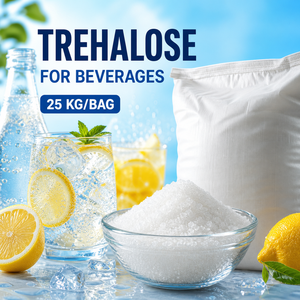
Commercial orders ship in 25 kg (55.1 lbs) food-grade multi-layer paper bags with moisture-barrier PE inner liners ( palletized at 1,000 kg per pallet), as well as 1,000 kg supersacks. Sample sizes (1 kg to 5 kg) are available for R&D trials.
No. Trehalose is a non-reducing sugar because its aldehyde groups are locked in the 1,1-glycosidic bond. It will not react with amino acids or proteins during baking or heat treatment, making it ideal for products where maintaining original color is essential.
Every shipment includes a lot-specific Certificate of Analysis (COA) covering HPLC Purity, Specific Optical Rotation ($+197^\circ \text{ to } +201^\circ$), Moisture Content, Heavy Metals, Arsenic, E. coli, and Salmonella, along with Kosher and Halal documentation.
Contact our supply chain team today to lock in volume pricing, request 1kg production samples, or receive a complete COA and specification dossier for your QA team.
Get Catalog